
Tenth Anniversary Edition · 2016–2026
Tony Soprano understood something about business that constitutional scholars occasionally overlook.
When one party controls another’s livelihood, a threat need not be particularly explicit.
Nice contract you’ve got there. Be a shame if something happened to it.
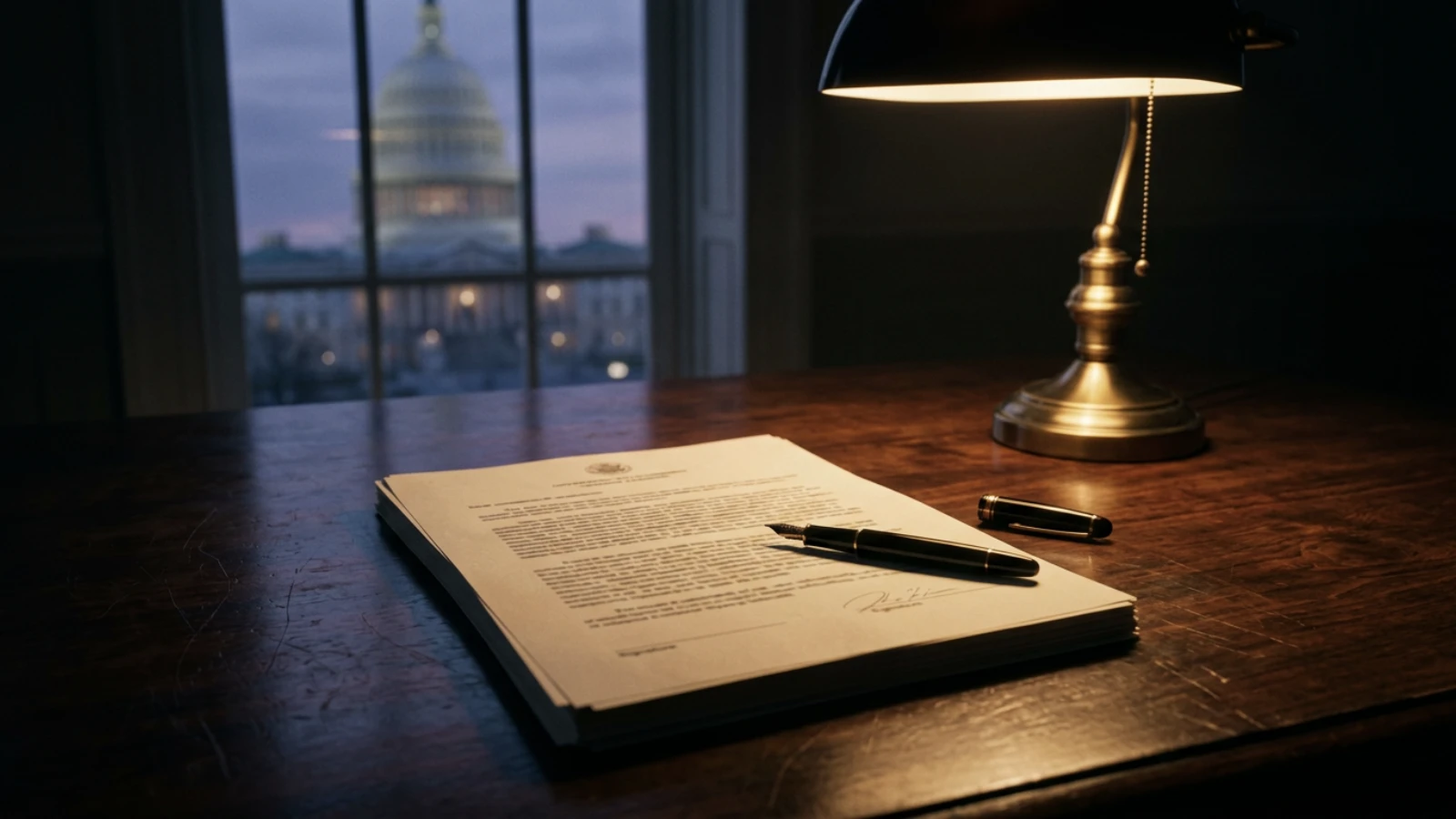
The fictional New Jersey mobster was not, admittedly, an authority on American government procurement. But he might have recognised the commercial logic of an executive order signed by President Donald Trump on 20 November.
The order requires federal contractors to notify the White House when Congress seeks information concerning their work with the executive branch. Companies must also follow instructions to withhold communications the administration considers protected by executive privilege. Failure to comply could put existing contracts and future government business at risk.
The White House describes this as protecting confidential presidential communications. We see something more troubling: an administration extending its influence over the very companies Congress may need to question.
What happens when the government being investigated is also the witness’s largest customer?
It is a constitutional question. But it is also a commercial one.
And investors should be paying attention.
Battening down the hatches
The timing is hardly accidental.
November’s midterm elections have handed Democrats control of both houses of Congress. When they take office in January, they will have the authority to launch investigations into the Trump administration’s spending, decisions and commercial relationships.
The White House, meanwhile, has been busy preparing for an altogether less agreeable Congress.
It has challenged the legitimacy of prospective investigations, tightened control over testimony by executive agencies and now instructed private government contractors to report congressional requests.
The pattern is unmistakable: the executive branch is extending its defensive perimeter beyond government departments and into the private sector.
Protecting genuine presidential confidences is a legitimate function of government. But Congress also has a constitutional responsibility to investigate how public money is spent.
Congress is not an invading army. It is part of the government.
The American Constitution deliberately divides authority among institutions that are not always expected to get along. The resulting friction is not a design flaw. It is rather the point.
The founders had recently disposed of a king. They were understandably reluctant to manufacture another.
Yet the idea that political authority should be restrained by recognised obligations was hardly invented in Philadelphia.
The rules before the ruler
In seventh-century Madinah, following the Hijrah of 622 CE, the Prophet Muhammad (peace be upon him) established an agreement that occupies an important place in the history of Islamic governance.
Known as the Constitution of Madinah, or the Charter of Madinah, it provided a framework for cooperation and mutual responsibilities among the city’s participating communities, including Muslims and Jews. It recognised their distinct religious identities while establishing shared obligations concerning security and communal affairs.
Its significance lies in a powerful principle: communities of different faiths could organise their common affairs through recognised commitments and responsibilities.
Centuries later, England’s King John accepted Magna Carta. Its original beneficiaries were a rather exclusive group. The barons were not campaigning for universal democracy; they had their own interests to protect.
Nevertheless, Magna Carta became an enduring symbol of a principle that would shape constitutional government: even the sovereign was subject to law.
The American founders inherited English constitutional traditions and Enlightenment political thought. They established a system intended to restrain concentrated authority, although their commitment to liberty coexisted rather awkwardly with slavery.
The Enlightenment, it seems, had not illuminated every corner of Philadelphia.
There is a fascinating historical connection worth remembering.
In 1765, Thomas Jefferson purchased a two-volume English translation of the Holy Qur’an. The books eventually entered the Library of Congress.
More than two centuries later, those very volumes were used by Keith Ellison, the first Muslim elected to the United States Congress, during his ceremonial swearing-in.
Jefferson’s Qur’an had returned to the Capitol for the ceremony of a Muslim congressman.
History occasionally displays a pleasing sense of symmetry.
Across different civilisations and centuries, societies have returned to a remarkably persistent question.
Who restrains the ruler?
In twenty-first-century Washington, that question has acquired an unexpected setting.
The federal government’s purchasing department.
The two-per-cent problem
Consider what happened on Wall Street just one day before Trump’s latest executive order.
Anthropic, the American artificial-intelligence company behind Claude, made its debut on Nasdaq.
Its initial public offering valued the company at approximately $1.5 trillion, making it one of the most valuable technology businesses ever to enter public markets.
The excitement was understandable. Artificial intelligence promises to transform industries, and investors are wagering extraordinary sums on the companies developing it.
But tucked into Anthropic’s IPO prospectus was a rather less glamorous disclosure.
Direct contracts with government agencies accounted for less than 2% of its revenue in each reported period.
Less than two per cent.
Earlier this year, a disagreement with the Pentagon over how Anthropic’s technology could be used had escalated into restrictions affecting defence procurement.
The dispute concerned national security. The Pentagon had its reasons, and Anthropic challenged its decisions.
But the most interesting commercial detail was not the disagreement itself.
It was the company’s warning that restrictions on government business could affect its relationships with private-sector customers and partners.
In other words, a company receiving less than 2% of its revenue directly from government agencies could face much wider consequences from government purchasing decisions.
Sometimes the most important customer is the one who never appears on your customer list.
This is precisely the sort of detail that should make an investment committee sit up.
A technology company may sell to a systems integrator, which sells to a defence contractor, which ultimately depends on the Pentagon. The government may represent a tiny fraction of the technology company’s direct revenue while exercising considerable influence over its commercial opportunities.
And the company in question may now be worth more than the annual economic output of most countries.
A government does not have to own your company to exercise considerable influence over its future.
Follow the money
Investors generally understand customer concentration. They examine contract renewals, revenue visibility and dependence on major buyers.
Government contracting adds another dimension.
The customer can also determine procurement eligibility, change purchasing priorities and decide which suppliers may participate in future programmes.
And Washington is an exceptionally large customer.
Booz Allen Hamilton, one of America’s leading federal contractors, recently reported approximately $40.9 billion in backlog. Around $24.8 billion consisted of options for future work that the government had not yet exercised.
That is roughly 61% of reported backlog dependent on further purchasing decisions.
The figures illustrate something investors should already know: a government contract may be valuable, but the government’s next decision can be considerably more important.
The exposure is not confined to defence contractors.
A software company may rely on commercial customers whose own revenues depend on federal contracts. A private-credit borrower may rely on public-sector renewals. A family office may own a business several layers removed from Washington while remaining exposed to decisions taken there.
Anthropic’s experience demonstrates how far that influence can travel.
Now consider the latest executive order.
Congress wants information about government spending and decisions. Private contractors may hold the answers. The White House expects to be informed when Congress comes asking.
And the same administration controls valuable contracts, renewals and future purchasing opportunities.
That is a considerable amount of influence to concentrate in one set of hands.
For a contractor, the calculation is uncomfortable. Cooperating with Congress may be a legal responsibility. Maintaining a healthy relationship with the federal government may be a commercial necessity.
Nobody needs to make an explicit threat for the potential conflict to become apparent.
The executive branch has inserted itself into the relationship between Congress and the private companies holding information about government activities.
That is a significant change in commercial incentives, whatever language Washington chooses to attach to it.
And it is the investment consequence that interests us most.
Political risk is often treated as something investors encounter in emerging markets, where political authority and commercial relationships can become uncomfortably intertwined.
It would be reassuring to believe that the world’s largest developed economy is immune to such considerations.
Anthropic’s experience and Washington’s latest executive order suggest that reassurance would be misplaced.
The risk is not simply that governments change their policies. Governments do that constantly.
It is that executive discretion can reach through apparently private commercial relationships, affecting businesses that may have little direct exposure to the state.
A trillion-dollar valuation offers no immunity from the purchasing decisions of government.
The republic and the purchase order
For centuries, societies have wrestled with the relationship between political authority and the obligations that constrain it.
The Charter of Madinah, Magna Carta and the American constitutional experiment emerged in different circumstances, but each belongs to that enduring conversation about governance, responsibility and restraint.
The question remains remarkably simple.
Who restrains the ruler?
In Washington today, Congress is preparing to exercise its constitutional oversight powers. The White House is preparing to resist scrutiny it regards as improper.
And private companies are being drawn into the contest.
The White House calls its latest intervention a defence of executive confidentiality.
We regard it as something more consequential: the extension of executive influence into the
commercial relationships on which congressional oversight may depend.
For investors, the lesson is equally important.
Government exposure cannot always be measured by the percentage of revenue earned from government contracts. The real dependency may sit elsewhere in the supply chain, in future procurement decisions or in the discretion of officials controlling the next opportunity to do business.
That is why Anthropic’s remarkable IPO and Trump’s contractor directive belong in the same conversation.
One illustrates the extraordinary valuations investors are prepared to place on American innovation.
The other reminds us how much commercial influence remains concentrated in Washington.
The founders understood the dangers of excessive executive power. They were rather less familiar with the modern federal procurement system.
Tony Soprano, on the other hand, would have understood the commercial arithmetic perfectly.
À bientôt, Basil
2016–2026 | Ten years of independent perspective.
Read it as a PDF
The original Pyrénées Capital edition, with full sources, formatted for print and offline reading.
About Pyrénées Capital
Pyrénées Capital is an independent Bahrain-based consultancy focused on cross-border investment origination, strategic introductions and relationships between businesses and investors. Founded in 2016, the firm works with family offices, institutions and international investment managers across markets.
For the curious reader
Selected primary records and contemporary reporting. Source titles are clickable.
- The White House – Contractor information and executive privilege directive, 20 November 2026
- Associated Press – Control of Congress following the November 2026 midterms
- Axios – White House clearance for agency testimony to Congress, 16 November 2026
- Oxford Academic – The Charter of Madinah: historical context and participating communities
- UK Parliament – Magna Carta and the development of constraints on sovereign power
- Library of Congress – Jefferson’s Qur’an and Keith Ellison’s ceremonial swearing-in
- Anthropic / SEC – November 2026 IPO prospectus, government exposure and risk factors
- Anthropic – Initial public offering and first trading information
- US Court of Appeals, D.C. Circuit – Pentagon–Anthropic procurement dispute, September 2026 judgment
- Booz Allen Hamilton / SEC – Quarterly filing: September 2026 contract backlog and priced options
Editorial note
This is independent market commentary, not personalised investment advice or a securities recommendation.