Tenth Anniversary Edition · 2016–2026
Today, Americans will gather around their dinner tables to celebrate Thanksgiving.
The tradition takes us back to Plymouth in 1621, when English colonisers and members of the Wampanoag nation shared a harvest celebration lasting three days.
According to the surviving eyewitness account, the Wampanoag brought five deer.
European colonisation brought smallpox, measles and a rather imaginative interpretation of land ownership.
As exchanges between civilisations go, it was not entirely equitable. [1]
Nevertheless, during my years living, studying and working in the United States, Thanksgiving became one of my favourite American traditions.
It is an occasion that requires no particular religious affiliation. There are no presents to buy, no gifts to exchange and remarkably little obligation beyond turning up with an appetite.
It is about families, friends and friendship. An opportunity to appreciate the people around us and the things we have in life, without expectation or obligation.
There is something rather beautiful about that.
Four centuries after that gathering in Plymouth, Americans will once again sit down to an abundant dinner. Considerable attention will be paid to the turkey. Rather less, one suspects, to everything that had to happen for dinner to arrive.
America was generously endowed with the natural resources necessary to feed itself.
Not everybody was quite so fortunate.
Nobody would mistake the Arabian Peninsula for the cornfields of Iowa.
Yet through the vision of their leadership and decades of sustained investment, the Gulf states have achieved something quite remarkable: providing citizens and residents alike with an abundant supply of food in one of the world’s most demanding agricultural environments.
Walk into a supermarket in Riyadh, Abu Dhabi, Dubai or Manama. The extraordinary variety of food available has become something we scarcely think about.
That achievement did not happen by accident.
And in researching how our dinner arrives, we discovered some rather unexpected things.
Bumblebees with boarding passes
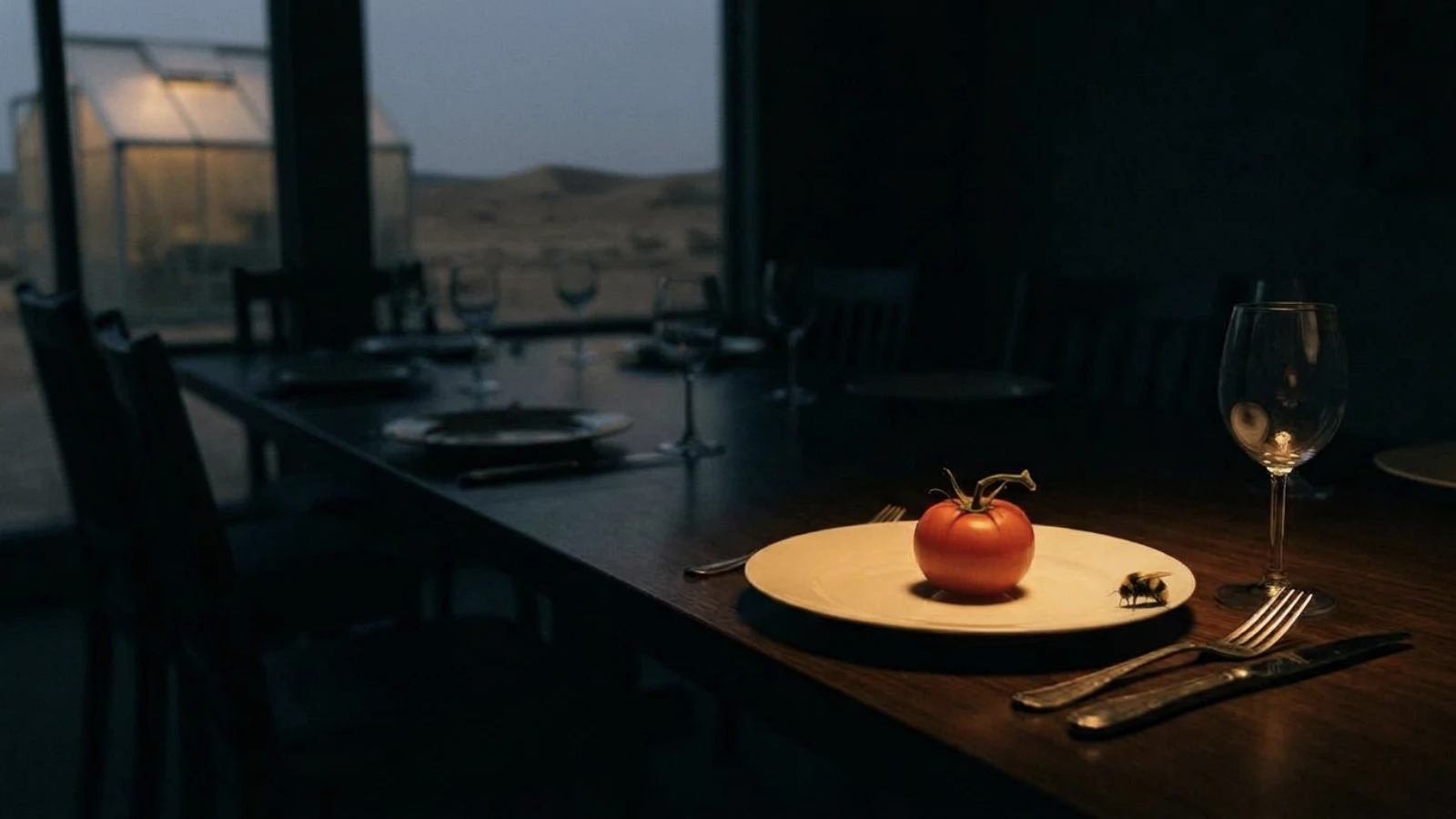
Consider the rather extraordinary journey of a tomato grown in Abu Dhabi.
During a reported visit to Pure Harvest’s greenhouse operations in Al Ain earlier this year, the grower explained that its pollinating bumblebees normally arrived by air. [2]
Bumblebees.
Few of us, one suspects, have given much thought to the international travel arrangements of insects.
Yet there is a good reason for their journey. Bumblebees are particularly effective at pollinating tomatoes. By vibrating their flight muscles, they release pollen from the flower in a process known as buzz pollination.
The tomato is Emirati. Some of the creatures responsible for its existence have a rather more international itinerary.
A sophisticated agricultural operation in the Arabian desert brings together international technology, specialised seeds, agricultural scientists, nutrients, environmental-control systems and airborne pollinators to produce something as ordinary as the tomato in one’s lunchtime salad.
There is nothing particularly ordinary about the achievement.
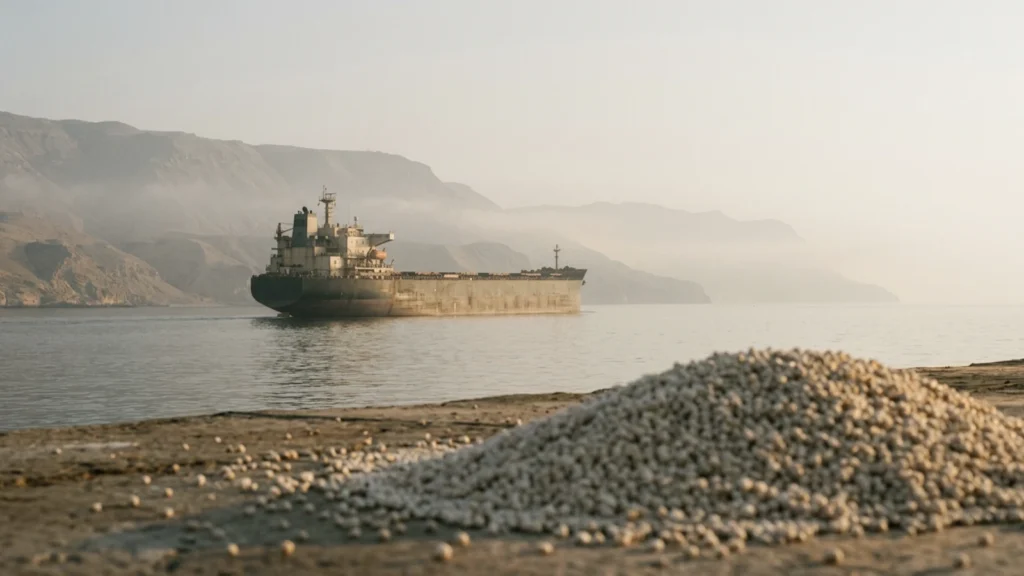
In an earlier Market Perspectives publication, we examined the importance of Gulf fertiliser exports to the world’s agricultural producers. Approximately one-third of global seaborne fertiliser trade normally passes through the Strait of Hormuz.
Now we are looking at that relationship from the other direction.
The Gulf helps feed the world. The world helps feed the Gulf.
And somewhere in this extraordinary exercise in international commerce is a bumblebee travelling by air.
An airline that bought a farm
Airlines own aircraft. Some own hotels. Others have interests in engineering businesses, freight companies and catering operations.
Emirates has gone rather further.
Its catering business owns a farm.
In 2022, Bustanica opened near Al Maktoum International Airport in Dubai, with a reported investment of US$40 million. Inside the facility, leafy vegetables grow in vertically arranged layers under artificial lighting, with nutrients and water delivered through carefully controlled systems.
Emirates Flight Catering subsequently acquired full ownership of the business.
The airline reported that its chefs had used 42,000 kilograms of Bustanica salads in a single year. [3]
One could board an aircraft in Dubai, eat a salad somewhere over the Indian Ocean and be consuming produce grown not far from the runway from which one departed.
There is an interesting commercial logic to this.
An airline catering business knows approximately how many meals it needs to prepare, when it needs them and the standards its ingredients must meet.
An agricultural business would very much like to know who will buy its produce, in what quantities and how regularly.
Putting the two together does not guarantee profitability. It does, however, bring the farmer considerably closer to the customer.
Investors spend considerable time examining the sophistication of agricultural technology. Perhaps we should devote a little more attention to the sophistication of the commercial arrangements surrounding it.
The most important feature of an advanced farm may not be its technology.
It may be knowing who is coming to dinner.
The greenhouse with a drinking problem
In 2019, researchers at Saudi Arabia’s Estidamah agricultural research centre discovered something rather peculiar about growing tomatoes in Riyadh.
The greenhouse was considerably thirstier than its inhabitants.
Approximately 85% of the measured cultivation water in a conventional greenhouse went into keeping the building cool rather than irrigating its tomatoes.
Eighty-five per cent.
By modifying the greenhouse design, researchers achieved a reduction of approximately 40% in water consumption per kilogram of marketable tomatoes whilst producing more fruit per square metre.
Imagine spending years looking for more efficient ways to water a tomato, only to discover that the greatest opportunity was effectively in the air-conditioning system.
Another Saudi experiment went further. Plants naturally release moisture through their leaves. By recovering that moisture through condensation, researchers demonstrated that a greenhouse could produce a kilogram of fresh tomatoes using little more than four litres of additional water. [4]
A greenhouse that drinks its own perspiration.
The next scientific challenge is achieving such remarkable resource efficiency whilst reducing the energy required to operate the system.
What is particularly encouraging about Saudi Arabia’s investment in agricultural research is that its scientists are addressing challenges that are becoming increasingly relevant to growers elsewhere in the world.
Through sustained investment in knowledge, the Kingdom is developing expertise with potentially considerable international commercial value.
Six years to improve a piece of plastic
The Netherlands is internationally renowned for its greenhouse technology.
Keeping plants warm is one of the challenges its agricultural engineers have had to address.
Saudi Arabia faces a rather different assignment.
What if, instead of spending money removing unwanted heat from a greenhouse, one could prevent some of it entering in the first place?
Researchers at King Abdullah University of Science and Technology spent years developing materials designed to reject part of the sun’s heat whilst allowing useful light to reach the plants.
Their work became the basis of products commercialised by iyris, a Saudi-origin agricultural technology company that announced a US$16 million financing round in 2024. [5]
Now consider a farmer in California, confronted with the expense of keeping his crops productive during periods of extreme heat.
Where might some of his future agricultural technology come from?
Possibly Saudi Arabia.
There would be a rather pleasing historical irony in a Californian farmer turning to the Arabian Peninsula for advice on growing vegetables.
And the commercial proposition is particularly interesting.
A company selling improved greenhouse materials does not necessarily need to acquire agricultural land, employ farmers or negotiate with supermarkets.
It can sell its technology to growers who already do those things.
Its potential customers may be in Spain, Mexico, Australia, Africa or the United States.
The investment opportunity is not limited by the size of Saudi Arabia’s agricultural industry.
The UAE is pursuing similarly interesting avenues of research. Through the Mohamed bin Zayed Water Initiative’s Al Miyah Challenge for Agriculture, competing technologies are being tested in actual growing conditions in Al Ain. Silal is working with international specialists to investigate crop genetics and resilience to environmental stresses. [6]
The ambition extends beyond finding better machinery. It includes developing plants better able to tolerate difficult growing conditions.
These programmes illustrate the foresight behind investing in scientific research. Governments can establish the institutions and provide the conditions for experimentation. Entrepreneurs can develop commercial applications. Investors can help take successful innovations into international markets.
If an agricultural technology can prove itself in Al Ain in August, it may have some rather interesting customers elsewhere.
For us at Pyrénées Capital, the opportunity is particularly interesting. The vision and sustained investment of Gulf leadership are creating possibilities not only for international businesses entering the region, but also for Gulf-developed technologies entering international markets. The movement of expertise and capital need no longer be in one direction.
The Gulf’s distinctive climate could become one of its greatest advantages in the development of agricultural technology.
Something to give thanks for
Today, somewhere in America, a family will sit down to Thanksgiving dinner.
There will be friends, relatives, laughter, perhaps a few disagreements and almost certainly more food than anybody requires.
I remember those occasions with considerable affection.
What made them special was not the turkey, the cranberry sauce or even the rather extraordinary American enthusiasm for pumpkin pie.
It was the people.
The opportunity to sit around a table with people who welcomed you into their lives, without expectation or obligation.
There is a universality to that sentiment.
Here in the Gulf, hospitality and sharing food have occupied an important place in our culture for generations. The circumstances may be different, the dishes may be different, but the pleasure of welcoming somebody to one’s table is remarkably familiar.
Perhaps today, alongside appreciating the people around us, we should give a little thought to those whose vision, ingenuity and dedication ensure there is something on the table to share.
And to my American friends, and to those with whom I have shared many a Thanksgiving dinner over the years, wherever you may be today:
Thank you for the memories.
Happy Thanksgiving.
À bientôt, Basil
2016–2026 | Ten years of independent perspective.
Read it as a PDF
The original Pyrénées Capital edition, with full sources, formatted for print and offline reading.
About Pyrénées Capital
Pyrénées Capital is an independent Bahrain-based consultancy focused on cross-border investment origination, strategic introductions and relationships between businesses and investors. Founded in 2016, the firm works with family offices, institutions and international investment managers across markets.
For the curious reader
Selected research, historical records and corporate disclosures. Source titles are clickable.
- Thanksgiving and European colonisation – Plimoth Patuxet Museums · Smithsonian historical timeline
- Bumblebees and international agricultural supply chains – The National: UAE food supplies · Pyrénées Capital: Hormuz fertiliser
- Emirates and Bustanica – Opening of Bustanica · Acquisition · Catering and salad consumption
- Saudi greenhouse research – Greenhouse cooling and water consumption · Closed-greenhouse water recovery
- Saudi agricultural innovation – KAUST: iyris commercialisation and investment · SABIC: greenhouse materials
- Emirati agricultural innovation – Al Miyah Challenge for Agriculture · Silal and Limagrain: crop resilience
Editorial note
Research cut-off: 26 November 2026. Historical references to disease concern the broader consequences of European colonisation, not transmission at the 1621 gathering. Scientific results relate to specific experimental conditions. This is independent market commentary, not personalised investment advice or a securities recommendation.