Tenth Anniversary Edition · 2016–2026
It doesn’t get any more boring than fertiliser.
Even the word is boring. The last time I thought about fertiliser was twenty years ago, spreading fresh mulch in my mother’s rose garden in England.
I have since discovered that it is considerably more interesting than the average presidential press conference.
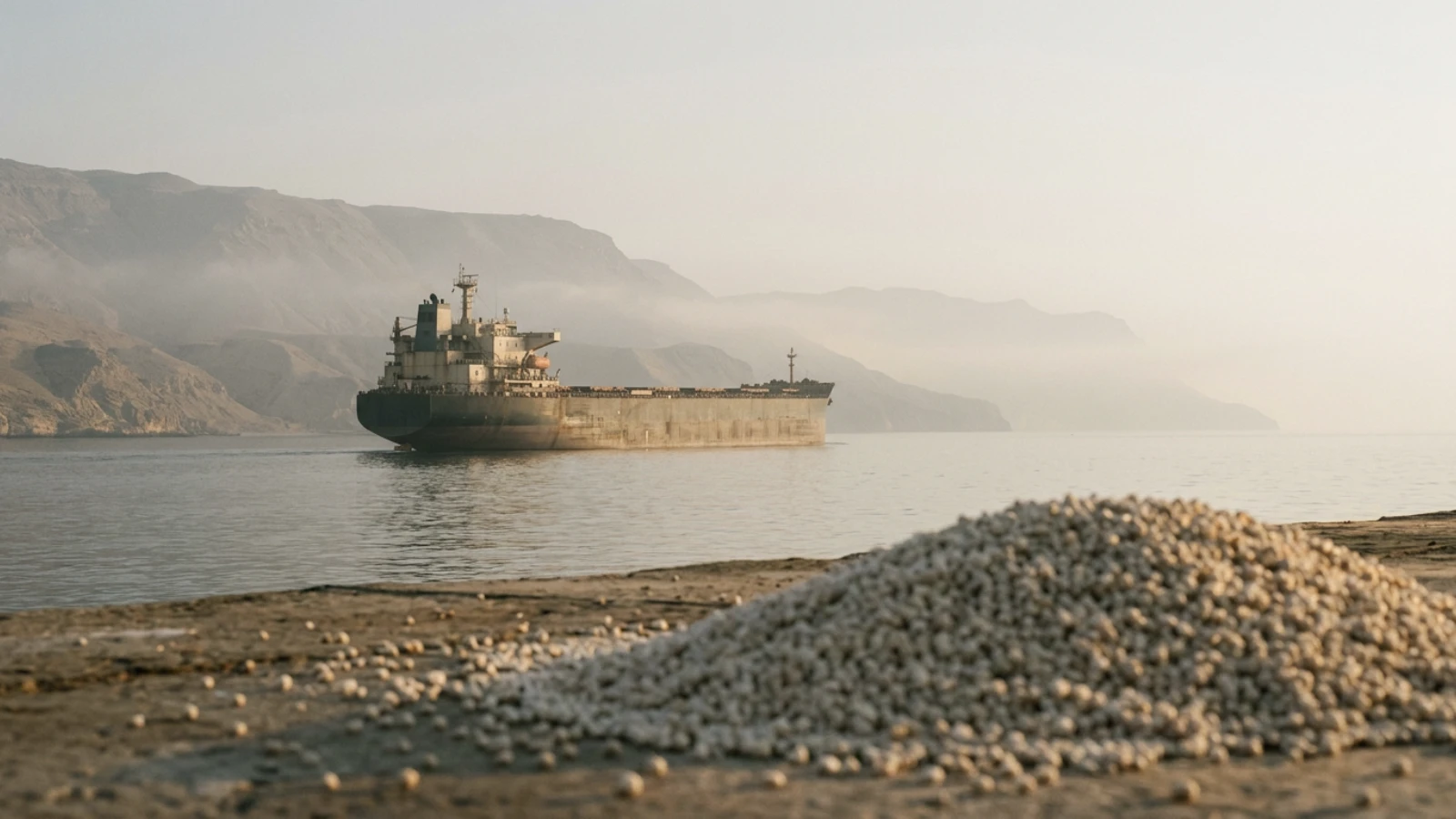
According to UN Trade and Development, approximately one-third of the world’s seaborne fertiliser trade — some 16 million tonnes annually — normally passes through the Strait of Hormuz. [1]
One-third.
It is a remarkable figure for something that rarely makes the evening news. Oil can get you to the supermarket; fertiliser helps grow the apples on its shelves. When a strait becomes a battlefield, the journey from an industrial plant in the Gulf to a family’s dinner table suddenly becomes rather more interesting.
Kent has long been called the Garden of England. Iowa grows vast fields of corn. Across Asia, rice farmers prepare their next planting. They do not all buy fertiliser from the Gulf — nor do all crops require the same ingredients — but their costs are connected to the same international markets. The disruption need not reach every farm directly to reach the price of food.
Oil gets presidents, generals, aircraft carriers and an apparently limitless supply of television commentators. Fertiliser has farmers.
The president and the inconvenient arithmetic
President Donald Trump has been celebrating the recovery of oil shipments. On 23 October he said, citing the Wall Street Journal, that more oil was passing through Hormuz than before the war. Unfortunately, the figures told a different story. Regional exports across all routes had risen above 24 million barrels a day, but shipments actually passing through Hormuz were estimated at about 14 million — still below their pre-war level. [2]
Saudi Arabia had redirected oil through its pipeline to the Red Sea; the UAE could use Fujairah, beyond the strait. That was resourceful work by Gulf producers under difficult conditions. But a bypass is not the same thing as an open road. Congratulating Hormuz on the oil leaving through other ports is rather like congratulating Heathrow on its punctuality because passengers landed at Gatwick.
Trump subsequently claimed a weekly record for oil shipments through the strait. The publicly available comparison did not substantiate it. No doubt the White House would be pleased to provide the figures. Presidential enthusiasm, however, is not yet a recognised unit of maritime measurement. [2]
There is an equally important question behind the oil statistics. Who considered the cargoes that never appear in a presidential speech?
Who was in the room?
On 3 January American forces captured Venezuela’s Nicolás Maduro in Caracas: a rapid operation with an unmistakable target. It made compelling television. Iran was never going to be another Venezuela. A country of Iran’s size, geography and regional connections cannot be reduced to a single dramatic scene.
And yet the attractions of a swift, decisive result are not difficult to imagine. Reuters reported that Israel’s prime minister pressed for military action and presented intelligence about an opportunity to strike Iran’s leadership. The governments coordinated closely; Trump ultimately authorised the operation. What assurances were exchanged privately is not established. What happened after the first bombs fell is considerably more visible. [3]
Reporting by The New York Times, republished by The Irish Times, describes a remarkably small circle around the decision. The US energy and Treasury secretaries were excluded from key pre-war discussions. That does not establish whether agricultural officials assessed the risks elsewhere. But it does make one wonder whether somebody asked what a disrupted Gulf shipping route would do to an Iowa farmer’s fertiliser bill — or a Moroccan factory’s next delivery of sulphur. [10]
The military objectives may fit inside a briefing room. The economic consequences do not.
The stated nuclear justification also deserves examination. Iran’s Supreme Leader had declared nuclear weapons religiously forbidden, a position Iran presented to the IAEA in 2005; the precise formal status of that prohibition has been disputed. A religious declaration, of course, cannot substitute for verification. [4]
The 2015 nuclear agreement introduced verified restrictions. America withdrew in 2018; Iran later exceeded the limits, raising serious proliferation concerns. Yet US intelligence assessed in March 2025 that Iran was not then building a nuclear weapon. The IAEA continued to raise serious questions about enrichment and safeguards. These were not imaginary concerns, but neither was an active weapons programme an established fact. Diplomacy and military action were choices with different risks. [4]
Destroying a target is one operation. Accounting for what follows is another.
The Gulf pays the bill
For decades, the Gulf has invested in becoming a crossroads of the world. Airports connecting continents, hotels welcoming travellers, ports moving goods, financial centres attracting capital. Reliability was not merely a slogan; it was an economic asset.
The Gulf countries did not collectively decide to begin this war. The United States and Israel launched strikes on 28 February; Iran subsequently attacked targets in Gulf states and bears responsibility for those attacks. The region has endured consequences from decisions it did not collectively make.
Consider a hotel in Bahrain. The building is sound. The staff arrive. The rooms are spotless. The airport may even have reopened. But the guests have postponed their visit. A Dubai airline can restore a timetable without restoring the demand that once filled its seats. A family office can remain open for business while the transaction it was negotiating quietly slips into next year.
The tourism industry estimated substantial daily losses across the wider Middle East during the early disruption. Allianz Research later projected far-reaching cumulative losses for Gulf output through 2030. Such forecasts are not money already lost, but the direction of travel is hardly comforting. [5]
Gulf governments, airlines, ports and businesses deserve credit for adapting. Decades of infrastructure investment have helped them preserve vital services. Yet even capable leadership cannot conjure back the customers, time and confidence consumed by somebody else’s war.
Resilience should not be confused with responsibility for creating the crisis.
The missing ingredient
Now travel to Morocco. It has enormous phosphate resources and factories that turn them into fertiliser. Yet processing phosphate also requires sulphur. Much of that arrives from abroad; in 2025 Morocco imported about 2.34 million tonnes from the UAE alone. [6]
Picture the factory. The mine is working. The machinery is ready. The customer is waiting. Somewhere beyond the Atlantic coast, however, the ingredient that makes the entire process possible is delayed by a war a continent away. A rather dull cargo turns out to be the difference between a functioning production line and an expensive wait.
China has its own complicated fertiliser supply chains: nitrogen products going out, sulphur coming in, and production adjusting when those flows falter. Different nutrients, different constraints, the same awkward lesson. A declaration about energy security is welcome; a fertiliser factory would probably prefer a delivery date. [6]
Two straits, one shopping bill
Hormuz is only one of the region’s maritime bottlenecks. Further west, Bab el-Mandeb leads towards the Red Sea and Suez. It remains navigable, but a shipping company deciding whether to send a valuable vessel through troubled waters must consider more than the nautical chart.
A ship can be diverted, insured at a higher price or held while somebody negotiates cover. Avoiding Bab el-Mandeb can turn a journey that ordinarily takes weeks into something far longer. Every additional day consumes fuel, crew time and working capital. Meanwhile the importer waits, the factory adjusts, and the eventual customer wonders why prices have changed. [7]
The bill rarely arrives with a neat label reading “cost of war”. It emerges as a different shipping quotation, an extra financing charge, a larger government subsidy or a farm supplier’s less encouraging price list.
India has worked to protect fertiliser availability while increasing subsidy support. That is a sensible way to shield farmers, but somebody must still finance the protection. In Iowa, a grower preparing for next season faces higher quoted ammonia costs than earlier in the year. The precise farm bill depends on crop, acreage, timing and many other factors; no responsible analysis can attribute every increase to this war. But the farmer has to buy the fertiliser before he can sell the harvest. [8][9]
He may never have heard of Bab el-Mandeb. He may not wish to. He has fields to plant, equipment to repair and a weather forecast to watch. The price of the inputs, however, has a considerably wider geography than the field.
Wars have a remarkable ability to travel further than the armies fighting them.
When the cargo moves, the capital follows
For investors, the point is not simply that some prices go up. One disruption can reach a Gulf hotel, an Asian importer, a Moroccan manufacturer and an American farm by entirely different routes. The hotel loses guests. The importer needs financing. The manufacturer looks for another supplier. The farmer decides how much risk he can afford before planting.
There may also be opportunities: more resilient supply chains, alternative trade routes, better storage and the capital to keep viable businesses operating through uncertainty. But opportunity is not the same as opportunism. A business that can adapt may be a sound investment; one that survives only because someone else absorbs its losses may be considerably less attractive.
This is the practical relevance for Pyrénées Capital’s cross-border work. We connect capital, investors and commercial opportunities across markets. The important questions are often less glamorous than the headlines: Who holds the stock? Who finances the delay? Who can pass on the additional cost? And who is left holding the invoice?
Who decided? Who pays?
Wars are described in objectives, targets and timetables. Commerce is less obliging. A family can postpone a holiday; a ship can change course; a farmer cannot postpone the growing season simply because a briefing has gone well.
There is something wonderfully convenient about declaring victory before anyone has finished counting. It makes excellent television. International trade is rather less susceptible to applause.
Washington can celebrate the barrels. The rest of the world is entitled to examine the invoice.
And so we return to the most boring cargo in the world. Fertiliser. The stuff in my mother’s rose garden, in the soil beneath Kent’s orchards, and in the fields that help put dinner on the table. One-third of its global seaborne trade passing through a narrow stretch of contested water. That is no small footnote to a war.
After all, the Iowa farmer cannot fertilise his fields with a presidential victory claim.
À bientôt, Basil
2016–2026 | Ten years of independent perspective.
Read it as a PDF
The original Pyrénées Capital edition, with full sources, formatted for print and offline reading.
Download PDF of “The most boring cargo in the Strait of Hormuz”
About Pyrénées Capital
Pyrénées Capital is an independent Bahrain-based consultancy focused on cross-border investment origination, strategic introductions and relationships between businesses and investors. Founded in 2016, the firm works with family offices, institutions and international investment managers across markets.
For the curious reader
Selected reporting and data underpinning this editorial. Source titles are clickable.
- UN Trade and Development – Hormuz and global seaborne fertiliser trade
- Wall Street Journal / Kpler – Oil exports: Hormuz versus alternative routes
- Reuters – US–Israeli deliberations ahead of the conflict
- US Intelligence / IAEA – Nuclear assessments, enrichment and safeguards
- Allianz Research / WTTC – Gulf economic exposure and tourism disruption
- IFPRI / Policy Center for New South – Fertiliser markets and Morocco’s sulphur dependency
- UN Trade and Development – Shipping routes, detours and Bab el-Mandeb
- Government of India – Fertiliser stocks and subsidies
- USDA / Iowa State University – Ammonia quotations and agricultural costs
- The Irish Times / New York Times – Reporting on the pre-war decision-making circle
Editorial note
Figures are drawn from the cited publications and describe the periods and methodologies stated there. Forecasts are not realised losses; illustrative economic effects should not be attributed exclusively to the war. The analysis reflects information reviewed through 20 November 2026. This is independent market commentary, not personalised investment advice or a securities recommendation.